
When the Nerveless Nocks stunt team opens for its 28th
season at the Tommy Bartlett Show in the Wisconsin Dells, 7-year-old Cyrus
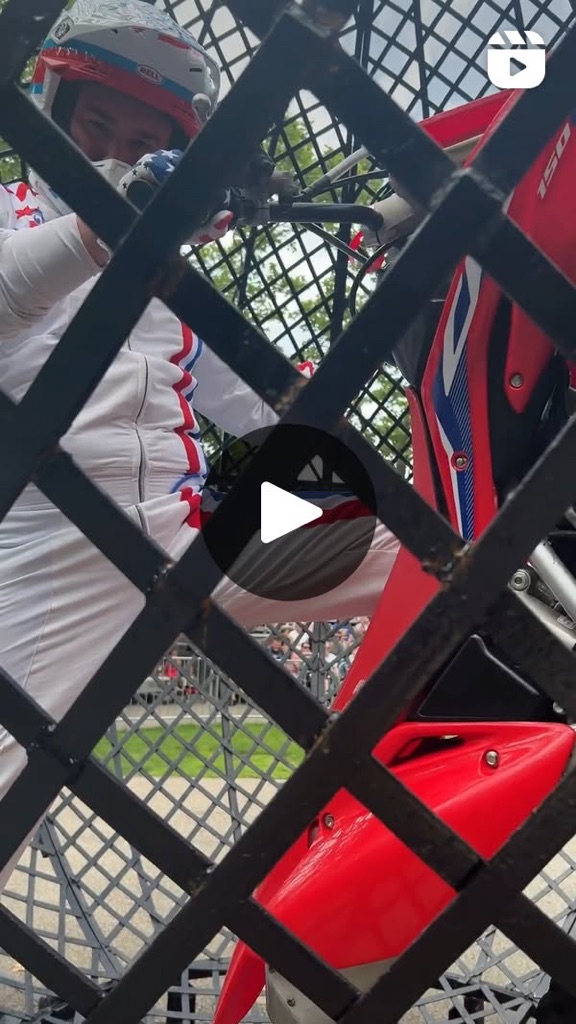
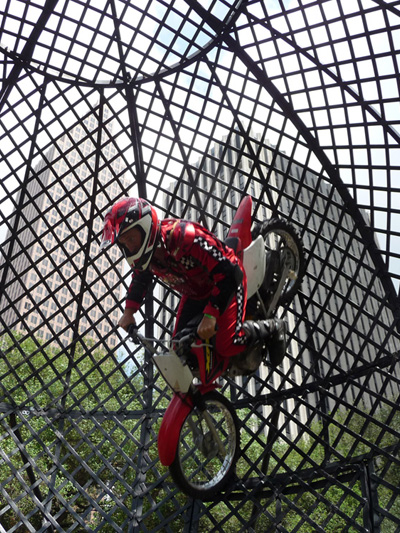
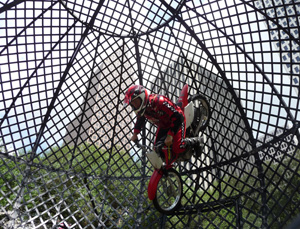
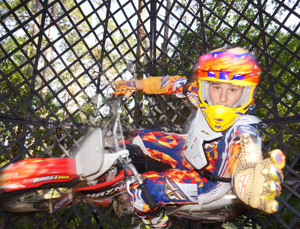
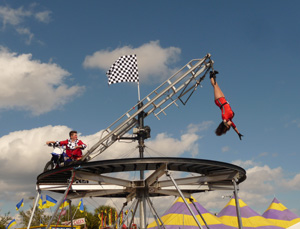
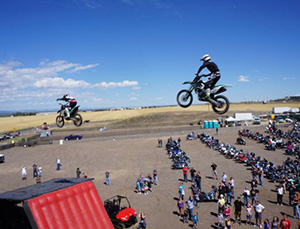
Nock will race his pint-size motorbike inside the Globe of Thunder while
his mom, Carolina, screams “Slow down!” According to Nock’s father,
Michelangelo, “The World’s Youngest Motorcycle Daredevil” tore the
house down last summer, noting Cyrus is carrying on a nine-gen-eration,
160-year family tradition. “The thrill and excitement of performing in
front of an audience is in our blood,” the proud father says.
Meanwhile, at Raging Waters in San Dimas, California,
Nikolas and Erendira Wallenda’s three kids, a
ges 2, 4,
and 7, will take turns putting on a costume and displaying their innate
sense of balance in the Fabulous Wallendas’ show. “When Evita, the
youngest, was maybe 6 months old, Nik could just hold out his hand and she
could perfectly balance in his palm. People would be stunned,” says Tom
Rhein of Cincinnati’s Coney Island, where the legendary high-wire family
has been a favorite since 26-year-old Niko-las’s great-grandfather Karl
Wallenda, a Ringling headliner for two decades, made his first appearance
at the park in 1948. Nikolas was just 9 years old when his parents
made their Coney Island debut.
For these circus aristocrats, spending the summer performing
at an amusement park is as much a part of growing up as learning to tumble
and walk the low wire. Why do the parks bring them back year after year?
According to aerialist-turned-talent agent Mitzi Gill of Star Attractions
in Las Vegas, Nevada, “Daredevil thrill attractions are always
popular because when people see something they can’t even imagine doing,
they are simply awestruck.” Gill’s database of 2,900 acts and shows
includes the Nocks and the Wallendas, as well as the Winns’ Thrill Show
and the Smiths’ Human Cannonball Team. “The families are large,” says
Gill, “and the skill is handed down to sons and daughters who grow up and
go on the road.”
The Nerveless Nocks
The Tommy Bartlett Show has been producing water ski,
sky, and stage shows in the Wisconsin Dells for 53 years, making it one of
the longest-run-ning live entertainment shows in existence. “The
Nocks have filled the bill for the aerial part of our show for 28 years,”
says Tommy Bartlett Show President and CEO Tom Diehl.
The Nerveless Nocks owe their name to Queen Elizabeth II,
who pronounced them “simply nerveless” after a command performance of
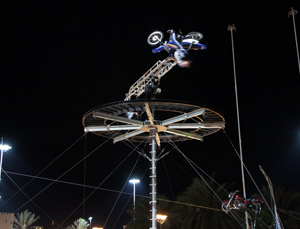
their signature sway pole act in 1954. Michelangelo Nock,
president and CEO of Nerveless Nocks Entertainment Productions, Inc.,
is now the leader of the troupe his father, Eugene, an
d uncle, Charles, headlined with Ringling Brothers. He recalls
how the original pine poles brought over from Europe would dry and crack.
“I’m glad they switched to steel before we came along,” jokes
Michelangelo, whose father’s motto was “Safety first!” Michelangelo and
his brothers Eugene Jr., John, and Bello (the current Ringling Bros.
headliner) began performing the sway pole act at the Tommy Bartlett
Show as teenagers.
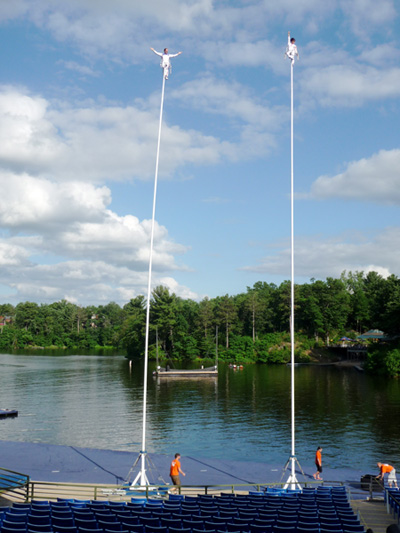
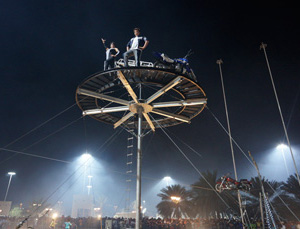
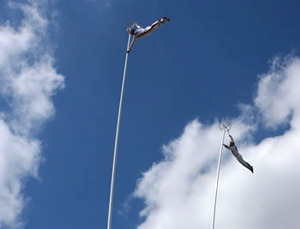
The hallmarks of the act are a hand-over-hand,
foot-over-foot run up to the top and daring mid-air exchanges. “It stops
people in their tracks because they see we’re not wearing any
harnesses,” Michelangelo explains. “It’s a slick surface, 100 feet
straight up. There are no nets.” In the finale, which is staged for the
greatest possible audience reaction, the performers wrap their legs around
the poles, spread their arms, and plunge headfirst to the ground. “People
will run from their seats because they hear you scream and think you’re
going to fall on them. At the last minute, you grab the pole and stop,”
says Michelangelo, whose costumes get shredded by the friction. “My dad
always said, ‘Boys, when you’re learning, your first reaction is to let go
when you feel the burn. Squeeze harder, because if you let go, you’re
going to die.’”
“In the world of the performing artist, seeing a real person
doing something really daring still captivates,” says Gene Columbus, vice
president of entertainment staffing at Walt Disney World, “and I think it
will still captivate 100 years from now, and 500 years from now.” Columbus
and his wife, Becky, have been like family to the Nock boys since they
toured internationally with Disney on Parade from 1970-1976. “It was the
best place to grow up,” says Michelangelo, who made his stage debut at age
5 in “Peter Pan” and was enchanted by Dumbo’s Circus and Mickey Mouse
walking the high wire. “The stage was like a big playground floor with all
these props and characters.”
When the Nerveless Nocks arrived at Tommy Bartlett in 1978,
Diehl helped the shy youngster overcome his stage fright. “Every year, we
have a free kids’ show for all the schools within a 45-mile radius, so I
asked him to juggle for the kids. That broke the ice,” Diehl recalls. The
next season, the 11-year-old was training on a 10-foot sway pole with a
safety harness, an act his 13-yearold daughter, Angelina, is now learning.
She already performs a hula hoop act and appears in the ad for the
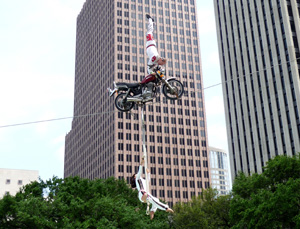
SkyCycle attraction at Tommy Bartlett’s Exploratory. “Basically it’s a
bicycle up on a high wire that simulates what the Nocks do on their
motorcycle high wire,” says Diehl, who credits Michelangelo for technical
assistance on the design. “It’s got a counterbalance and couldn’t possibly
tip over, but when people get strapped in, their eyes are the size of
silver dollars.”
Asked to name the aerial feat that takes his breath away, no
matter how many times he’s seen it, Diehl, like Columbus, names the Nocks’
helicopter act, in which Michelangelo performs trapeze stunts while
hanging 250 feet in the air from a chopper piloted by his brother, Eugene
Nock Jr., president of Nock Entertainment Group, Inc.
“It’s noisy, it’s windy … you have to keep your composure,”
Michelangelo says of his aerial acrobatics. “You can’t get excited. You
can’t lose your cool. … I concentrate for a month and practice the act
over and over again in my back yard at my stunt ranch in Sarasota (
Florida), so when I get up there, it’s like I’m 10 feet off the
ground.”
The helicopter act is just one of many the Nocks keep in
their repertoire. Since the average guest comes to Tommy Bartlett every
three years, they rotate the set. One thing remains the same, though:
Michelangelo still sells programs and signs autogr
aphs, just as he did as a teen. “People come by and say, ‘Hey,
I remember you,’” he says.
The Fabulous Wallendas
Picture yourself sitting neck deep in the wave pool at
a park enjoying a really cool show. As you watch in amazement, a daring
couple performs acrobatics 50 feet in the air. “When you come to a
waterpark you don’t expect to see a high-wire act, and then you don’t
expect to see one the caliber of the Wallendas,” says Tony Brancazio,
general manager of Wet ’n Wild Emerald Pointe in Greensboro, North
Carolina, where the Fabulous Wallendas have performed for the past two
years. “People tell their friends and word spreads and keeps building
every year.”
Karl Wallenda, the patriarch of the family, famously said,
“Life is on the wire. Everything else is just waiting.” His
great-grandson, Nikolas Wallenda, now leads one of the troupes carrying on
the family tradition of wire walking, while also encompassing such thrill
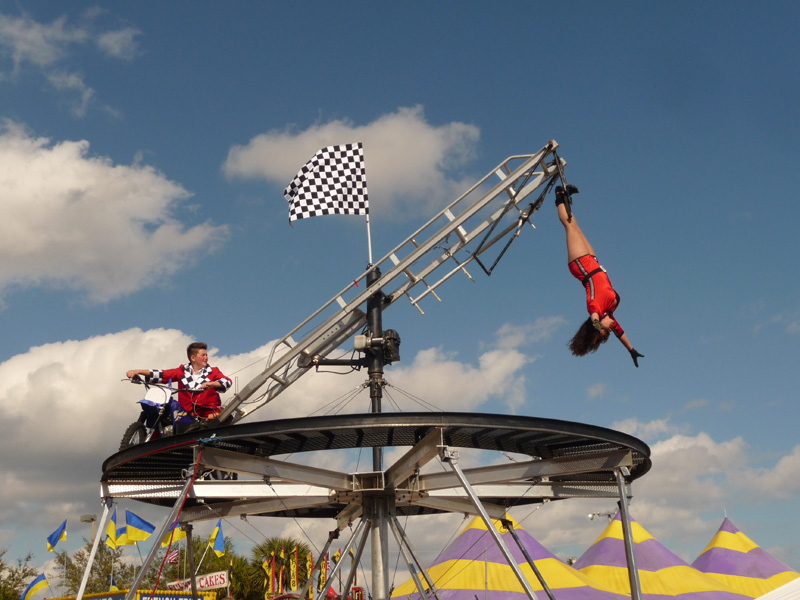
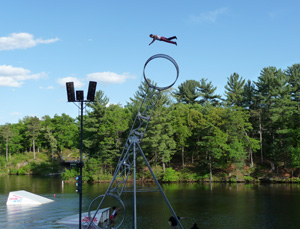
attractions as the motorcycle on the wire, the giant space wheel, and a
sway pole that bends all the way down to the ground. “I like to mix it up
a little bit,” says Nikolas, president of Wallenda Family
Entertainment, Inc. “It keeps us on our toes and gives the public
something new to see every year.”
“We were the first Palace Entertainment park to bring
them in,” says Bran-cazio, who met the Wallendas at IAAPA Orlando 2002.
The idea of shopping for another high-dive or jet-ski show was
jettisoned after seeing Tom Rhein’s photos of the Fabulous Wallendas
wowing the crowd at Coney Island’s Sunlite Pool.
“The waterpark is such an active environment and it’s very
spread out, so people have a tendency to ignore the hourly announcements
of what time the show is going to be,” says Brancazio. “But as soon as the
Wallendas get up there, people pay attention, because you definitely don’t
ignore somebody who’s 50 feet up a high wire. Because of our success, a
few of our other parks have taken a look and will probably do
something in the future.” While Nikolas and his wife, Erendira, will
make their debut at Raging Waters in San Dimas this summer, the show will
go on at Wet ’n Wild Emerald Pointe with his mother, Delilah, and sister,
Lijana, performing. 
“Because the Wallenda name has such a long
history—generations of fans have watched them—[the performance] also
attracts a lot of senior visitors who bring their grandchildren to go
swimming, and they get to see the Wallendas, too,” says Brancazio, who
believes that any new attraction in a park is just another draw that adds
to the overall atmosphere of entertainment. “It’s one more thing to do
while you’re here, and it’s something that appeals pretty much across the
board.
“We’ve gotten so many TV stations coming out to cover their
practice rounds and interview them, and newspapers doing feature stories,”
Brancazio adds. The press coverage recaps the family’s triumphs and
tragedies, including the famous accident that killed two wire walkers and
seriously injured another during a 1962 performance of the troupe’s
signature act, the seven-person pyramid. Tom Rhein, who was in the
audience in Detroit, Michigan, when the Wallendas first performed the act
after a 20-year hiatus, describes “the thunder of applause when they
all stepped off that wire. It is probably one of the most amazing
theatrical performances that I have ever seen. It makes you think
that we do have the ability to just transcend our fears.”
In 2001, the Wallenda grandchildren and great-grandchildren,
who perform with their respective families, came together at Japan’s
Kurashiki Tivoli Park to set the Guinness world record for an eight-person
pyramid. In preparation for the six-minute feat, they practiced an average
of four hours a day, six days a week, for five months. “If one of us goes,
we all go, which was proven in Detroit when the seven fell in ’62,”
Nikolas says. “You don’t push something like that.
There’s a difference between practicing at 10 feet and
performing at 30 feet. It’s all in your mind, but if that pyramid jerks
about an inch to the side, it feels like two feet when you’re 30 feet off
the ground.” 
The family’s most popular act remains the pyramid, though
the seven-person version is too costly for most parks because it involves
so many Wallendas. An alternative is the three-or four-person pyramid. “We
kicked it back and forth a couple of times, whether they’d come out here
and do a pyramid, or a record,” says Brancazio. “That’s just one of the
things we’re talking about doing in the future.”
When the show is over, Nikolas gladly signs autographs and
fields questions. Teenagers and young kids will often ask, “Where are the
magnets in your shoes?” “They think nothing is real anymore, that
everything is modern technology,” observes Nikolas, “so they don’t
believe that people really risk their lives for entertainment.” A lot
of times people have to feel the bottom of his shoes or see the bottom of
his feet before they’ll believe he really did balance on a high wire
that’s a mere five-eighths of an inch wide.
Star Attractions
When Mitzi and Ron
Gill retired from a 30-year career as iron jaw aerialists in circuses and
stage revues, they parlayed their industry contacts into a successful new
business. Founded in 1981, Star Attractions matches quality
entertainers with parks and other venues. The company’s extensive
database includes such categories as aerial artists and thrill
attractions, along with variety acts such as living statues and one-man
bands.
One of the Gills’ most dynamic acts is the Smith family of
Human Cannonballs. “You know how they have that countdown, 5-4-3-2-1,
before the cannon is fired? They tell me the Smith kids could count
backwards before they learned to count forwards,” Mitzi says with a laugh,
referring to David Jr., Jennifer, and Stephanie, who have performed solo
or as a team with their father, David Sr.
“The cannons are really an excellent investment because
they draw a lot of media, having appeared on television specials over
the past few years,” Mitzi adds. During a father-son dueling cannon
competition for “Guinness World Records Prime Time” in 1998 at Kennywood,
located just outside Pittsburgh, Pennsylvania, David Smith Sr. broke
the world record for farthest distance by a human cannonball—185 feet
10 inches. Since then he has broken his own record with a shot of 200
feet 4 inches.
Guinness world record holders and former Ringling performers
have a cachet, as do “the world’s tallest (fill in the blank).” “We’ve had
clients say, ‘What do you have that’s a good draw that we can use to get
people acclimated to a new area of the park?’ I have a lot of places
where the cannons were used as a big publicity burst to get something
started but have become an annual event,” says Mitzi, whose longtime
residence in Sarasota, Florida, and attendance at IAAPA Orlando made her
aware of theme parks as a viable market for these shows.
“What gets me about the Cannonballs is their apex is
about 70 feet, and when they start to come down they look at the net and
then flip over on their back,” she says. “They don’t see the net until
they hit. Now that’s incredible!”